
How to accompany your baby's sleep well
Useful information and tips for parents
Why the baby's sleep is so important
Recovery and development are promoted during sleep. While the baby sleeps, its brain processes new impressions. Synapses, connections between nerve cells, are formed during sleep. The more of these connections exist, the better the baby can process impressions. Growth hormones are also released during deep sleep. Good sleep is therefore not only important for recovery but also for healthy development and growth. The definition of good sleep differs significantly between babies and adults.
How do babies sleep?
In the first months of life, sleep and wake phases are distributed over the day and night. This is already the case before birth and continues for quite a while afterwards. Only gradually does your child learn the difference between day and night. Babies need not only closeness at night, but also food through breastfeeding or feeding, especially in the first months. Only gradually does your child learn the difference between day and night.
“To be able to fall asleep relaxed, the conditions for a baby must be right: it must be full, feel safe, comfortable, and secure.”
Why babies sleep differently
Sleep phases are divided into deep sleep phases and light sleep phases, the so-called REM sleep. During the so-called Rapid Eye Movements, the eyes move quickly under the closed lids. Unlike adults, where REM sleep occurs towards the end of an average 90-minute sleep cycle, the light sleep phase in infants occurs before the deep sleep phase. No wonder babies often wake up immediately after falling asleep. After about 20 minutes of REM sleep, the baby then transitions into deep sleep. Now it can usually be put down. After about 50 minutes, it wakes up again more or less briefly, often due to hunger, and checks again if it can continue sleeping safely. When the baby gets tired, it should be accompanied to sleep promptly. If falling asleep does not succeed, it often takes about an hour until another suitable time interval for sleeping occurs. This can lead to babies sometimes becoming overstimulated and crying for a long time until the next sleep window opens for them.
Every child sleeps individually
Babies sleep an average of 14-17 hours daily - regardless of the time of day or night. The total duration gradually decreases but remains quite individual overall. For example, babies aged four to eleven months sleep an average of twelve to fifteen hours - with some needing only ten hours and others eighteen. Often, there are mismatched expectations regarding sleep duration and frequency. This also applies to sleeping through the night. Babies do not fall asleep at a parent-friendly time in the evening and wake up only the next morning. Therefore, in studies on baby sleep, sleeping through the night is defined as a continuous sleep duration of five to six hours.
How to support your baby's sleep
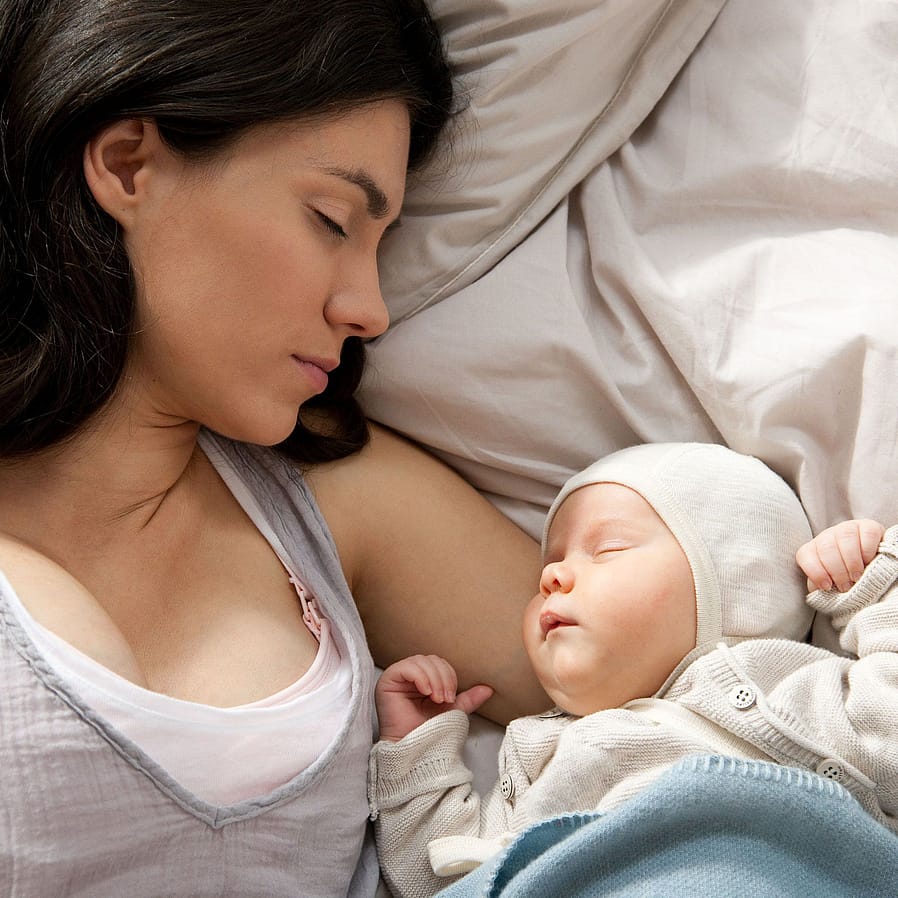
Phases in which babies sleep more restlessly are normal. Especially during growth spurts, developmental leaps, or teething, the current sleep rhythm of the children often gets temporarily disrupted. During these times, it is particularly important for parents to take good care of themselves to accompany the baby with love and security through restless times.Zahnen Basically, the rule is: babies only sleep when they are really tired. Tiredness often does not follow a schedule or the time of day but rather the daily feeling - which is why babies, just like adults, sometimes become tired earlier or later. To be able to fall asleep relaxed, the conditions for a baby must be right: it must be full, feel safe, comfortable, and secure. Parental closeness and also breastfeeding fulfill all these needs. A cozy, well-tempered, well-ventilated, and safe sleeping place is important. Most importantly, your child needs to feel and know that you are there.
Restful baby sleep: Tips for parents
Parents can do a lot to ensure their child falls asleep feeling secure. Create a suitable sleeping environment. Your baby should have enough space in the side bed, baby bed, and especially in the family bed. Avoid stuffed animals, pillows, and blankets, and use a baby sleeping bag that is adapted to the temperature and season. The ideal room temperature is 18-20 degrees Celsius. However, good ventilation and absolute smoke-free environment of the room are most important. Get advice from your midwife on safe baby sleep.
Support falling asleep with rituals
Recurring rituals before sleeping calm and provide security.
- Support rituals: A warm bath or a gentle massage signals to the baby that it will be accompanied to sleep afterward.
- Calm the baby: Soft humming or singing, quiet music, or gentle rocking, such as when carrying, can contribute to the relaxation and calming of your child.
- Pay attention to signs of tiredness: The baby loses interest in playing, yawns, or rubs its eyes? This can mean that it is tired. Respond to your baby's tiredness signals in time before it becomes overtired and possibly overstimulated.
- Do not skip daytime sleep: Babies who are overtired have a harder time falling asleep. Naps during the day are therefore important for nighttime sleep quality.
How a Baby's Sleep Patterns Change
A child around six months old discovers the world a little more each day and constantly learns new things. At night, the many impressions are processed, and sleep patterns can change significantly. Infants statistically wake up more often than they did at three or four months. So, it's completely normal if the nights suddenly become more restless again. After all, a lot is happening: The baby is developing motor skills, starting to move by crawling and later by creeping. Each "step" away from their caregivers also brings uncertainty, which the baby processes through closeness and physical contact, such as cuddling or breastfeeding. A child around six months old discovers the world a little more each day and constantly learns new things. It discovers exciting things that invite play and expands its field of vision and movement. At night, the many impressions are processed.
Why the Baby Needs Closeness at Night
For some children, there is hardly any time for breastfeeding during the day because they are constantly curious and want to explore everything, and they are easily distracted even during meals. They still meet their high energy needs by drinking more frequently at night. But even for children who consume enough breast milk and perhaps some solid food during the day, the frequency of waking up at night increases again. The brain processes new experiences—even at night. Additionally, children seek reassurance at night that their mother is still there. It's not just about food intake when children want to drink more frequently at night. Emotional replenishment is equally important for babies.
How Parents Can Set the Stage for a Good Night During the Day
Many parents are unaware of how much their daily routine affects their children's sleep. Many babies sleep better when they have calm, rhythmic days. A child who is already eating solid food should always have a substantial dinner that fills them up. Children who don't eat well in the evening should be breastfed extensively before sleeping. A calm bedtime routine is beneficial for a peaceful night: Babies "can't" handle much after late afternoon. Even if the child sleeps at 8 PM, the calm evening should begin at that time. A quick shopping trip to the nearby supermarket shortly before seven can significantly delay sleep for children under three, as they need to process the many impressions first.
Tips for Good Parental Sleep
When nights become more restless with the baby, parents need understanding for the baby and good self-management. Small breaks during the day, like a nap with the baby, can help recharge. Often, there is a longer sleep phase before midnight, so it might be beneficial to go to bed with the baby, even if the desire for self-determined time is strong. Parents can discuss how to navigate sleepless times as a family: Who could help to ensure there are one or two quiet hours for rest? Enough sleep is essential, as chronic fatigue increases the risk of accidents and makes parents less sensitive to the child's needs. Parents can apply for household help through their doctor and health insurance.