
Small Nettle – Urtica urens
Botanical Profile and Effects
Difference between Large and Small Nettle
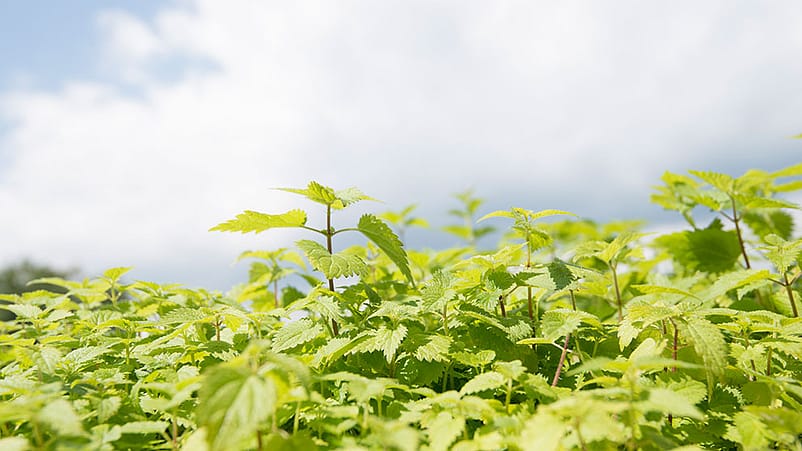
Due to its small size, the Small Nettle (Urtica urens) is somewhat less noticeable than its relative, the Large Nettle (Urtica dioica), but all the more intense in its effect. Apart from the significant size difference, the two plant species can also be easily distinguished by other characteristics: The Large Nettle is darker, more gray-green in color. The Small Nettle shines in rich green. Its leaves are rounded and not as pointed.
Touched – and burned
The Small Nettle often grows in fields, by the roadside, or on wasteland and usually goes unnoticed until we accidentally touch it. Because it has a feature that leaves an impression: its stinging hairs. The moment skin and nettle touch, there is an immediate reaction of the skin. Burning, itching, redness, and welts are symptoms it triggers. But not only the skin reacts. Our whole attention, our consciousness also focuses on the burning. The small plant manages to bring us completely into the moment, into the here and now.


Botanical Features
Leaves and Stems of the Small Nettle
The annual plant reaches a maximum height of 60 cm. Its leaves have deeply serrated, toothed edges covered with upright stinging hairs. The leaves sprout in pairs on opposite sides of the stem; each pair grows at a 90-degree angle to its predecessor. This is called decussate leaf arrangement. The stem of the Small Nettle is square. This is a feature of most nettle species. It is also covered with stinging hairs.
Flowers and Nuts
In summer, flower clusters sprout from the leaf axils, consisting of a multitude of tiny, spherical flowers. The Small Nettle is monoecious, meaning that both male and female flowers can be found on one plant. After fertilization, small, lens-shaped nuts develop – these are the fruits of the plant.
How does the nettle sting?
The entire plant is covered with rigid, silica-rich stinging hairs. These can penetrate the skin barrier upon contact. A mixture of formic acid, acetylcholine, histamine, and serotonin then enters the tiny wounds, leading to the characteristic burning and redness of the skin. Precisely because of this circulation-promoting, warming reaction, nettle was formerly used externally to treat rheumatism.
Effect as a Medicinal Plant
Since ancient times, nettle has been used as a medicinal herb. In the Middle Ages, it was used medically by Hildegard of Bingen and the scholar Paracelsus, among others. The mineral-rich nettle was also attributed with blood-stopping properties, which is why it was used in wound treatment and menstrual complaints.
Extracts from the small nettle help to relieve burning pain and regulate inflammatory processes. Due to these properties, extracts of the plant are used in Anthroposophic medicine to treat insect bites, sunburn, and minor burns.
Extra Tips: Versatile Use of Nettles
Nettle Tea
Since nettle tea or a tea cure is not suitable for everyone, one should consult with a doctor, especially in cases of pre-existing conditions.
If there is no objection to consumption, then harvest the nettle best before its flowering period, approximately from March to May. Don't forget gloves! You can prepare tea from both the large and small nettle. Use the leaves fresh or dry and store them. Nettle tea is said to have diuretic, anti-inflammatory, and detoxifying effects. Therefore, it is traditionally drunk for urinary tract infections and rheumatism. Nettle is said to block histamine release and thus have a soothing effect on hay fever.
Nettle Vegetable
Since earliest times, nettle has accompanied humans as an easily available and quickly renewable food source and medicinal plant. Somewhat forgotten, it is now reclaiming its place in modern cuisine as a wild vegetable. The young leaves are used, for example, as a spinach substitute.
«Soft» Nettles on the Skin
Nettle fibers can be spun into a fine thread. Clothing made from nettle fibers is among the oldest textiles in the world. Nettle was formerly known as the poor man's linen. Both light and comfortable, nettle fabric is being rediscovered today as a material for its attractive sheen and warming, skin-friendly properties.